Samuel Ryde photographs Roger Darlington
June 15th, 2023 by Roger Darlington
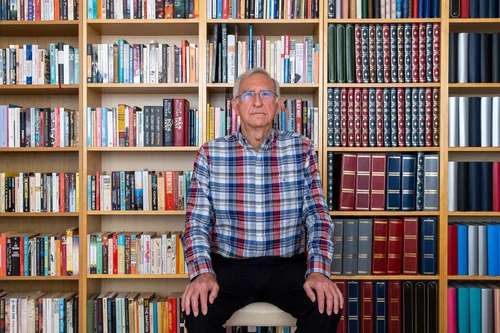
London photographer Sam Ryde has just completed a photographic project hosted by the Bankside Hotel in central London where Sam was the artist in residence. As part of this project, he photographed a number of people living close to the hotel in their own home. I was one of his subjects and this what he had to say about me.
This is Roger. Another Bankside resident kind enough to let me into their home. Your home is your biggest legacy. It reflects every piece of you, whether that is conscious or subconious and I find that fascinating. Sometimes it’s the things we don’t do that say the most about us. Roger’s library dominates the living room and screamed at me to be the back drop for our time together. As we were speaking I mentioned I had a photo diary that was eleven years old, he stopped and said, “come with me”.We walked into the spare bedroom and in front of me were a complete set of diaries that Roger has maintained every single day for 60 years. He told me he hasn’t missed a day, which is the first question people ask me about mine.
1. How long have you lived in Bankside?
Four years aka not long enough!
2. What’s your favourite thing about Bankside?
The closeness to everything: National Theatre, British Film Institute, Royal Festival Hall, Tate Modern, The Globe
3. What has been the biggest change you have noticed in your time here?
We are becoming a mini Manhattan: Southbank Tower, One Bankside, Bankside Yards and to come 18 Blackfriars Road
4. Do you think you’ll stay here forever?
I would love to!
5. What’s your secret Bankside tip?
The Sea Containers Hotel has a Curzon cinema which is open to the public for weekend showings of the latest films.
Posted in My life & thoughts | Comments (0)
A review of the Len Deighton novel “Winter”
June 8th, 2023 by Roger Darlington
Sometimes a book sits on the shelf for such a long time before it is read. This novel was bought for me in 1988 but it took me until 2023 before I actually read it.The Winter of the title is not a season of the year but the name of a German family and this epic novel – it runs to 536 pages – tells the story of that family from 1899 to 1945. Harald Winer is a Berlin businessman who invests in Zeppelin airships. He marries an American and they have two sons, Peter and Pauli, who respond in different ways to the political turmoil of the new Germany.
This family history is a prism for examining the First World War, then the rise of Nazism, and finally the Second World War. Leighton was a prolific author and did a formidable amount of research, so this novel is very readable and illuminating, but it follows so many characters over such a long period of time that one could really have done with a dramatis personae at the beginning.
Posted in Cultural issues, History | Comments (1)
A review of the 2019 film “Le Mans ’66”
June 7th, 2023 by Roger Darlington
I’m no petrolhead. I don’t own a car and I don’t even drive. But this car-racing movie is a cracker. That’s because it’s a well-written, character-driven film pitting corporate bureaucracy against individual flair.The corporation is the American Ford motor company which decides in the mid 1960s that it wants to make its image more exciting by winning the Le Mans 24-hour race which had traditionally been dominated by the Italian company Ferrari.
The individualistic over-achievers are American former racing car driver, now designer, Carroll Shelby and top driver and engineer, the British Ken Miles. The support roles are well-cast but Matt Damon, as Shelby, and especially Christian Bale, as Miles, are terrific.
Director James Mangold does a fine job keeping the excitement going for some two and a half hours which earned him a nomination for Academy Award for Best Picture.
As the ending tells us: “The Ford GT40, developed by Shelby and Miles, won Le Mans in 1966, 1968 and 1969. It remains the only American-built car ever to win the 24 hours of Le Mans.”
Posted in Consumer matters | Comments (0)
Would a universal basic income work? Let’s try it.
June 6th, 2023 by Roger Darlington
“A universal basic income of £1,600 a month is to be trialled in England for the first time in a pilot programme.This is the opening of an article about a trail of UBI in Britain. I hope that the trial is successful. The numbers look small and one needs to beware of the Hawthorne effect.Thirty people will be paid a lump sum without conditions each month for two years and will be observed to understand the effects on their lives.
Two places in England have been selected for the micro pilot scheme: central Jarrow, in north-east England, and East Finchley, in north London.”
Posted in British current affairs | Comments (0)
A review of the 2020 film “23 Walks”
June 5th, 2023 by Roger Darlington
The title could be off-putting but, in fact, there is very little counting, although there is a lot of walking (and talking) in this London-based relationship movie.Dave (played by Dave Johns who was so good in the eponymous role in “I, Daniel Blake”) and his large dog Tillie come across Fern (played by Alison Steadman, beloved of all British television viewers) and her little dog Henry on the first of these walks and start an off/on/off relationship that is more than usually complicated by both of them being in the autumn of their lives.
The story is both written and directed by Paul Morrison who is himself in his 70s and his spell as a psychotherapist brings some grit to the narrative. Recommended for something a little different. You can find it on Netflix.
Posted in Cultural issues | Comments (0)
Why men lose their friends – and how they can make more
June 2nd, 2023 by Roger Darlington
“In the UK, research by the Movember Foundation in 2018 found 27% of men said they had no close friends at all. They also found that friendships become less strong as men get older, with 22% of men aged 55 and over saying they never see their friends. It would seem there is, for men at least, a friendship recession.”
But:
“… studies have shown, the single biggest predictor of our psychological health and wellbeing, our physical health and wellbeing, and even how much longer we’re going to live, is the number of close friendships and family relationships we have.”These are quotes from an interesting article on male friendships, especially in later life. The article explains why so many men have few meaningful friendships, but why it’s so important that they have such friendships.
Now I’m a man who is 75 this month. I don’t support a football team; I don’t play golf; I don’t go to pubs. By rights, I shouldn’t have any close friends. But I do and I know that they’re very important to my mental and physical health. However, most of these friends are women because I find that they understand better than men the importance of strong social networks and are more willing to invest the time in them.
Posted in Cultural issues | Comments (3)
A review of the odd film “Harold And Maude”
May 30th, 2023 by Roger Darlington
I was chatting with an American friend and conversation turned to funerals. He mentioned a film from half a century ago – it was released in 1971 – that, in spite of being something of a film buff, I’d never heard of, let alone seen – so I looked it up.Harold (Bud Cort) is a young man in his late teens who has had a privileged but dysfunctional life which has resulted in him having a passion for (fake) suicide, an obsession with (yes) funerals and (understandably) a depressed personality.
At one of these funerals, he meets Maude (Ruth Gordon), a woman coming up to 80 who is even more eccentric than him but has an infectious exuberance for life. Somehow this movie manages to be both a black comedy and a love story with a life-affirming message.
When it was released, “Harold And Maude” was a critical and commercial flop, but it seems that, over the years, it has become something of a cult work. It’s certainly a curio. You might like to give it a go.
Posted in Cultural issues | Comments (0)
What is colour and is yours the same as mine?
May 30th, 2023 by Roger Darlington
“For a long time, people believed that colours were objective, physical properties of objects or of the light that bounced off them. Even today, science teachers regale their students with stories about Isaac Newton and his prism experiment, telling them how different wavelengths of light produce the rainbow of hues around us.But this theory isn’t really true. Different wavelengths of light do exist independently of us but they only become colours inside our bodies. Colour is ultimately a neurological process whereby photons are detected by light-sensitive cells in our eyes, transformed into electrical signals and sent to our brain, where, in a series of complex calculations, our visual cortex converts them into “colour”.
Most experts now agree that colour, as commonly understood, doesn’t inhabit the physical world at all but exists in the eyes or minds of its beholders. They argue that if a tree fell in a forest and no one was there to see it, its leaves would be colourless – and so would everything else. To put it another way: there is no such thing as colour; there are only the people who perceive it.”
This is a quote from a fascinating article about how we perceive colour. Indeed the piece comes to the conclusion that there is no such thing as (objective) colour. It seems that colour is in the eyes of the beholder.
Posted in Science & technology | Comments (0)
A review of the classic “Three Colours” film trilogy
May 28th, 2023 by Roger Darlington
“Three Colours: Blue” (1993)This was the first of a trilogy of films directed by Krzysztof Kieślowski and written by him and Krzysztof Piesiewicz. Taking their titles from the colours of the French flag and loosely inspired by the French national motto of Liberty, Equality and Fraternity, “Blue” represented liberty and is regarded as a classic. Set in Paris, the work is in the French language. Among the colour references, there is a sparkling glass hanging ornament.
Slow and portentous, this is a moving and poignant work. As Julie who loses her famous composer husband and young daughter in a car accident, Juliette Binoche is rarely off the screen and gives a wonderful performance. Music is central to her life and is used very effectively in the storyline. She proves to be an enigma, who herself has a discovery, and the main themes are those of loss, grief, and reconciliation.
“Three Colours: White” (1994)
This was the second of a trilogy of films directed by Krzysztof Kieślowski and written by him and Krzysztof Piesiewicz. Taking their titles from the colours of the French flag and loosely inspired by the French national motto of Liberty, Equality and Fraternity, “White ” represented equality and, while interesting, is not regarded as highly as “Blue” and “Red” which are genuine classics. Set predominantly in Warsaw, the work is mainly in the Polish language. Among the colour references, there is a recurring scene of a wedding.
“White” is very different in tone from “Blue” and “Red”. It is a black comedy with an element of romance that satirises the corruption of post-communist Poland where anything can be bought (even a body). Another difference is that the main character is male: Zbigniew Zamachowski as Karol, initially a simple-minded soul who finds that he is ready to do anything to win back his ex-wife (Julie Delpy).
“Three Colours: Red” (1994)
This was the third of a trilogy of films directed by Krzysztof Kieślowski and written by him and Krzysztof Piesiewicz. Taking their titles from the colours of the French flag and loosely inspired by the French national motto of Liberty, Equality and Fraternity, “Red” represented fraternity and is regarded as a classic. Set in Geneva, the work is in the French language. Among the colour references, there is a huge billboard advertisement for a brand of chewing gum.
There are two male/female interactions here, one intergenerational and non-sexual and the other more conventional and romantic, and the narrative intersects the two in an immensely moving and somewhat mystical manner. Valentine (Irène Jacob) is a good-natured young model and Joseph (Jean-Louis Trintignant) is a cynical retired judge brought together by an injured dog and a spot of spying and this unlikely couple change each other’s lives in ways that are unpredictable.
Note 1: Narratively there are only very small overlaps between the three films. In “Blue”, we briefly see a court scene featuring two of the main characters who will be in “White”. The very ending of “Red” has an incident involving the main characters of all three films.
Note 2: Each of the three films has a scene in which an elderly person attempts to place a bottle in a glass recycling bank. In the last film, the old person is helped by the lead character.
Note 3: Kieślowski announced his retirement from filmmaking after the premiere of “Red”. He died two years later.
Posted in Cultural issues | Comments (0)
“Roger And (Not) Out” – a memoir of my first 75 years
May 27th, 2023 by Roger Darlington
For the last nine months, I’ve had a major project: I wanted to produce a memoir in time for my 75th birthday on 25 June 2023. And I’ve done it. It was published this weekend.
For family and friends who will be attending my birthday celebration, a free, signed copy of the memoir will be given to you at the event. For everyone else, you can purchase a copy from Amazon at a very reasonable price.
I hope that you will find the memoir both informative and entertaining. If you like it, please post a short review. Thanks in advance.
You can buy “Roger And (Not) Out” here.
Posted in My life & thoughts | Comments (0)