Our Ethiopian odyssey (5): our first rock churches
February 9th, 2015 by Roger Darlington
Day 3 (MondayOur ) actually began in the night when the alarm in our hotel room went off at the crazy time of 4.30 am. It was a case of wash, dress, pack and have a “grab and go” breakfast before the Cox & Kings group boarded our minimbus at 5.30 am. We were soon at Addis Ababa’s Bole airport where security was very tight because of the constant threat of Al Shabab. We had our luggage – including jackets, shoes and belts – screened once as we entered the airport and then again when we had gone through passport control.
It was a short flight of just 50 minutes from Addis north to Mekele on a Boeing 737. A different minibus and driver awaited us. The vehicle was barely large enough to take all our luggage on the back seats and all the members of the group in rather cramped seats and there was no air conditioning, but this is a hardy group and ŵe managed fine.
During the reign of Emperor Yohannes IV (1872-1889), Mekele was the capital city of Ethiopia. Today it is the regional capital of the Tigray province and one of the country’s principal economic and educational centres with a population of around 140,000. It was the focal point for refugees and the relief effort during the 1984-85 famine and hosts the headquarters of the United Nations Mission in Ethiopia and Eritrea.
Our starting point as tourists today was a visit to the main market in Mekele where we spent half an hour wandering round with our guide Dawit. This is very much a local market and we were the only white people there. It is an open air market which has no roads or pathways but simply dusty earth or rocky spaces between stalls for locals to view and purchase mainly foodstuffs. Many of the women had their hair tightly braided in the Tigray style and several young men strode around with a pole across their shoulders from which hung a couple of dozen live chickens for sale.
From Mekele, we drove north to the town of Wukro and then took a dirt track out of town heading up to the hills. We came across a group which had attending a wedding and were waiting by the roadside for local transport and we gave a lift to four of the young women with their children slung in a cloth shawl on their back. Smiles were exchanged and photographs were taken. We dropped off out companions at their local village and headed to our destination – our first rock church of the trip.
The Church of Wukro Chirkos was built of sandstone carved out of the high rock face. Like all such churches, it looks nondescript from the outside but magical on the inside. The most striking feature is the decorated 15th century pillar depicting pictures of saints and angels. Like all Ethiopian Orthodox churches, it contains something called a ‘tabot’ which is a replica of the Ark of the Covenant allegedly located in Axum but no guests are allowed to see it. We were excited to find that the white-clad, bearded priest of the church made an appearance for us, holding his prayer stick and shaking his prayer rattle. An excellent photo opportunity.
After this lunch, we returned to the little town of Wukro where we had lunch at the Lwam Hotel. We sat outside in warm sunshine at one long table located In the plain hotel courtyard.
This meal was our introduction to the Ethiopian staple food known as ‘injera’. This is a flat spongy bread made of a very fine grain called ‘teff’. It has a rubbery feel and a slightly fermented tangy taste. Ethiopians have ‘injera’ spread thinly over a large plate and then pull off bits to scoop up the accompanying food. We had our ‘injera’ cut and rolled up with the other food on the side on a normal plate. The side dishes included chickpeas, lentils, split peas, spinach, tomato, and something called ‘tibbs’ (crusty fried steak’). We coped well but one of the dishes was really spicy and the steak was very chewy. This is not a country for desserts (poor Roger) and at this lunch dessert was simply a third of a banana.
After the meal, we set off to visit a second rock church. This involved a rickety ride of 40 minutes up a winding unmade road which clung to the side a low mountain and created a dust storm every time a lorry passed us. The absence of air-con meant that we opened windows but the approach of a lorry required that we quickly closed them.
The rock-hewn Church of Abraha We Atsbeha was constructed in the 10th century and is dedicated to the twin kings of Axum. It is bigger and more nicely finished than the church we saw in the morning and include pictures of Biblical scenes in 17th & 18th century murals.
On the road back from this church, we stopped to,observe and photograph a scene which could have come out of Biblical times. Five oxen were roped together and herded round and round in tight circles by a young child in order to thresh wheat underfoot of the animals. It was hot, dusty work but the boys had some ‘injera’ to keep them going.
Almost 12 hours after we had left our hotel in Addis Ababa, at 4.15?pm we arrived at our accommodation for this night. Located outside the town of Hawzjen, the Gheralta Lodge consists of a series of rock-walled chalets or bungalows complete with en suite facilities. Although perfectly adequate, the bedrooms had minimal facilities, so we were pleased that we had brought along our travel kettle and tea & coffee.
Posted in My life & thoughts | Comments (0)
Our Ethiopian odyssey (4): Addis Ababa
February 8th, 2015 by Roger Darlington
Day 1 (Saturday) of our trip was in fact essentially just a nighttime flight from London Heathrow airport to Addis Ababa Bole airport. All our flights – both external and internal – are with Ethiopian Airlines. This is the largest and most profitable airline in Africa and has recently been declared “African airline of the year” for the third year running. It was the first airline outside Japan to operate the Boeing 787 Dreamliner and we were delighted to find that this new airliner was our craft for the flight from London to Addis Ababa.
Take off was 8.30 pm. Roger has the remarkable facility of being able to sleep almost anywhere almost anytime, so he clocked up three and a half hours slumber. Meanwhile Vee, who can never sleep on flights, watched a couple of films: “The King’s Speech” and “The Big Lie”. It was a flight of just over six and a half hours and Ethiopia is three hours ahead of British time, so we landed 6.05 am local time.
We experienced a first when we were screened for Ebola with a handheld machine that checked the temperature of our forehead. Once through all the procedures, we met our local guide for the whole trip: Dawit (Ethiopians do not have family names) of Kibran Tours. At the same time, we met the other members of the Cox & Kings group: there are only ten of us – all very experienced and adventurous travellers, most of them our age or older (the oldest is almost 86), all British except for one American and one Brazilian, and we are the only heterosexual couple.
The journey from the airport to our hotel – the Radisson Blu – took less than a quarter of an hour but making rooms available to us took around an hour. Dawit made it clear that the first two days of our tour were going to be tough in terms of limited sleep. So we only had time for two and a half hours sleep in our room before we had to turn up for a buffet lunch.
The afternoon of Day 2 (Sunday) was spent on a short tour of Addis Ababa: just three and a half hours visiting three locations. The name Addis Ababa means ‘new flower’. The city was founded by Emperor Menelik in 1887 and today it is is the capital of modern Ethiopia and the political and commercial heart of the country with a population of 4 million. It is the fifth highest capital in the world at 7,726 feet or 2, 355 metres (we have been to highest La Paz in Bolivia).
After weeks of near freezing weather with occasional snow flurries in London, it was wonderful to feel warm sun on bare arms on an afternoon with a temperature in the mid 20s C (around 80F). As we drive though a city that is clearly undergoing a construction boom, we saw no less than three weddings which involved dancing in the street.
Our first stop was the Holy Trinity Cathedral which was built in 1944 to celebrate the country’s liberation from the Italian occupation. One of the graves in front of the church is that of Sylvia Pankhurst, the daughter of the famous Emmeline Pankhurst, who campaigned in Britain in the 1930s against the Italian takeover of Ethiopia. As we will have to do for all the churches we visit in Ethiopia, we had to remove our shoes before entering -a practice we usually associate with mosques or temples.
The church interior is fairly plain but it houses the tombs of the Emperor Haile Selassie and his wife. Also our study of the stained glass windows depicting various Biblical scenes, was the occasion for Dawit to narrate the colourful story of how King Solomon met and seduced the Queen of Sheba who subsequently gave birth to a son Menelik who allegedly brought the Ark of the Covenant to Ethiopia.
Our second visit was to the Ethnographic Museum which is actually located in the grounds of the Addis Ababa University. It was originally the palace of the Emperor and then, during the Italian occupation, the home of the Viceroy Graziani ( who was the subject of a failed assassination attempt). Outside the museum is an odd sight: a set of stone steps curving upwards and leading nowhere. The steps were erected by the Italians with one for each year of Mussolini’s rule but, following liberation, the Ethiopians placed on top a Lion of Judah, the symbol of the Ethiopian monarchy.
The rooms in the museum have lots of large panels with both Amharic and English text which explain the life and culture of the Ethiopian people – a mixture of races who speak no less than 80 languages and dialects.
Our third and final venue was the National Museum, a rather utilitarian-looking building housing some fantastic artefacts representing the origins of humankind in this part of the world. Again, conveniently, all the descriptions were in Amharic and English.
The most famous exhibit is the skeleton called Lucy which was discovered in 1974 by Donald Johnson in Hadar, part of the Great African Rift Valley, At some 3.18 million years old, it is the oldest complete hominid ever found, in fact, we only have 40% of the skeleton and she is only 105 cm tall and you could miss the plain case in which she is contained if it was not pointed out to you, Although Lucy is the most famous exhibit in the museum, there is an even older human skeleton called Ardi – another female, less complete, but 4.4 million years old.
The American in our group – a distinguished lady called Peggy from Boston – reminded us how many Americans cannot it accept this version of human evolution. But we have seen some of the most vital pieces of evidence.
Our evening meal was back at the Hotel Radisson and again was a selection from a wide choice of buffet.
**********
We need to get an early night now because we have to be up at 4.30 am tomorrow morning for our flight to Mekele.
Posted in My life & thoughts | Comments (0)
Our Ethiopian Odyssey (3): a few introductory facts and figures
February 7th, 2015 by Roger Darlington
So much for the ancient history of Ethiopia. What about modern times? The recent history of Ethiopia has involved the Derg socialist revolution and ‘the red terror’ (in 1974-75, between 100,000-500,000 were murdered), invasions (by Somalia in 1977 and of Somalia in 2006), famines (most infamously in 1984-85 when between 400,000-million died), and full scale war (with Eritrea in 1999-2000). So a model of stability, really.
A few basic facts about the nation:
- Ethiopia is located in the horn of Arica. It lost the province of Eritrea in 1993 and with it its coastline, so today it is a land-locked nation (the largest such in the world) which has borders with Eritrea in the north and north east, Djibouti and Somalia to the east, Kenya to the south, and Sudan and South Sudan to the west.
- It is a huge country geographically at over one million square kilometres (actually 1,104,300 sq kms or 426,371 sq miles) which makes it the 27th largest country in the world and four and a half times the size of the UK.
- The population is 90 million which makes the country the second most populous in Africa (after Nigeria and just before Egypt). Almost two-thirds of its people are illiterate.
- The official language is Amharic (a member of the Semitic language group, including Arabic and Hebrew), but English is widely spoken, and the local currency is the birr (about 30 to the British pound or 20 to the American dollar).
- The first multi-party election was held in 2000, but the government of the Ethiopian People Revolutionary Democratic Front (EPRDF) remains strictly authoritarian with a tight control on all media (including social media).
- Ethiopia is one of Africa’s poorest states, although it has experienced rapid economic growth since the end of the civil war and currently claims an annual growth rate of around 10%.
- Over 80% of the population still live in rural areas. The economy, therefore, revolves around agriculture, which in turn relies on rainfall, and it is one of Africa’s leading coffee producers.
- Ethiopia is one of the largest recipients of UK development aid, receiving around £300 million a year.
- One of the most famous singers is Mahmoud Ahmed (born 1941) and, before the trip, we bought and listened to one of his best known CDs called “Tizeta” (the word means ‘memory’). The newest thing in local music, however, is a movement called Ethiopiyawi electronic.
- Just over two-fifths of the population is Ethiopian Orthodox Christian (mainly in the north), while a third of the population is Muslim (mainly in the east and south).
- All of our trip is in Northern Ethiopia and “The Lonely Planet” guidebook to the country states: “For visitors to Ethiopia, it’s all about the north. Unlike anywhere else on Earth, northern Ethiopia has the ability to wow you day after day after day.”
**********
We fly to Ethiopia today and, subject to the availabiklity of WiFi locally, I’ll be blogging about the trip on a regular basis – so please keep visiting this blog.
Posted in My life & thoughts | Comments (0)
Our Ethiopian Odyssey (2): why we are going there
February 6th, 2015 by Roger Darlington
So why are we going to Ethiopia?
Well, besides the fact that we love to visit different countries and experience different cultures and we have already been to so many of the more popular destinations, Ethiopia has a long history, so mysterious as to be almost mystical:
- The earliest known hominine fossils come from the Afar region of Ethiopia and are 4.5 million years old.
- The earliest known stone tools come from Gona in Ethiopia and are 2.5 million years old.
- The earliest known modern-looking human skulls come from the Omo basin in Ethiopia and are about 130,000 years old.
- Therefore Ethiopia is known as the cradle of humankind and ultimately we are all descended from the first humans who started to migrate out of Ethiopia around 100,000 years ago.
- It is said to be the home of the mysterious Ark of the Covenant, a chest described in the Book of Exodus as containing the tablets of stone on which the Ten Commandants were inscribed, which allegedly was transported from Jerusalem some 3,000 years ago.
- Ethiopians believe that their rulers were descended from Menelik, child of the union between King Solomon and the Queen of Sheba, so that their last emperor – Haile Selassie who was deposed in 1974 – was the Lion of Judah, while Rastafarians worldwide believe him to be a messianic figure.
- It is the only country in Africa to possess an alphabet more than 2,000 years old.
- Christianity was introduced to the country in the 4th century and, according to the Orthodox Church in Ethiopia, it has been a Christian country for at least 1600 years when in the 5th century the ‘Nine Saints’ – Syrian missionaries – spread the court religion of Christianity among the people.
- The ‘father of modern Ethiopia’ is a man called Amda Seyon (also known as Gebre Meskel) who ruled from 1314-1344. He vastly expanded the size of the Christian Empire through the use of force and his rule is considered something of a golden age for Ethiopia.
- Ethiopia still uses the Julian Calendar instead of the Gregorian Calendar (introduced in 1582) which means that it is currently seven years and 113 days behind most of the world and has a 13 month year (12 lunar months of 30 days and one further month of five or six days depending on the leap year).
- Except for a brief occupation by Mussolini’s Italy in 1935-1941, it is the only African country – except for tiny Liberia – which has never been colonised, so it is Africa’s oldest independent country with its culture intact and unspoilt by European contamination.
Posted in Uncategorized | Comments (0)
Our Ethiopian Odyssey (1): why on earth go there?
February 5th, 2015 by Roger Darlington
Our latest trip – an organised tour with Cox & Kings – is to the African nation of Ethiopia and some of our family and friends have wondered why we would chose such an obscure country for a holiday. We must say that, after we had booked the trip and consulted our local surgery on any health matters we should address, we too wondered why we were going there as we had not anticipated the number of inoculations that would be necessary.
We already had the required cover for hepatitis A and yellow fever, but needed a course of four injections (at a cost of £30 a time) for hepatitis B, a course of three injections (at a cost of £65 a time) for rabies, another injection to cover diphtheria, tetanus and polio (there is currently an outbreak of polio in Ethiopia), and a further injection to up-date our typhoid protection. In total that was nine injections each at a total cost of £630.
As one nurse said: “You didn’t expect that you would be a pin cushion, did you?” No – nor a cash dispenser. We will have to regard it as an investment – at our age, we should be done for life now.
As well as the inoculations, we elected to take malaria tablets before, during and after the holiday (another £138 between us). Then there was the matter of visas: you need them to enter the country, the company recommended to handle the application of them charged us £82 each, and then they managed to return the passports with visas to a local tea packaging company. So inoculations, tablets, and visas added a grand total of £932 on top of the actual cost of the holiday (don’t ask).
Finally (!?!), there was the warning in our guide book that “figures suggest that at least half of all travellers will get diarrhoea at some stage”. So why are we going to Ethiopia?
Posted in My life & thoughts | Comments (0)
How much of China was occupied by Japan in World War Two?
February 4th, 2015 by Roger Darlington
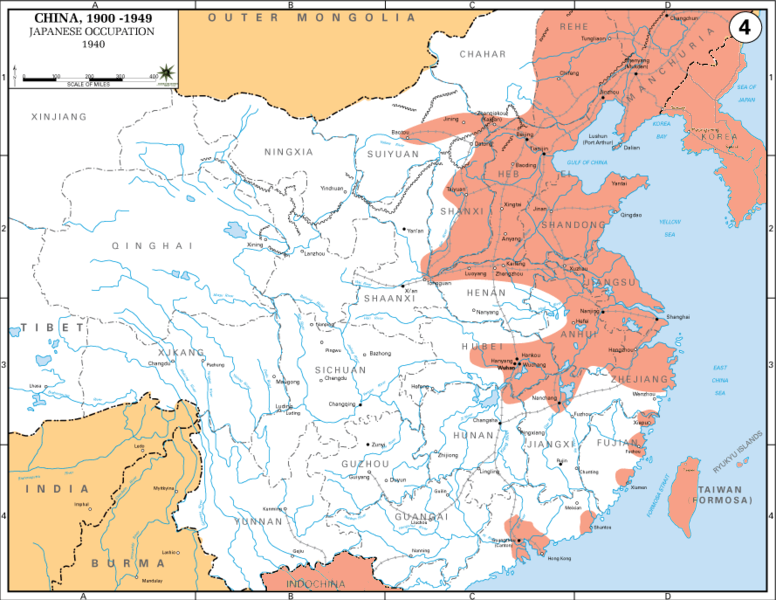
I’ve now attended four lectures on my City Lit course on Chinese history. The fourth lecture – which will be my last of the six because I’m off to Ethiopia – covered events during the Second World War.
I knew that Japan occupied Manchuria before the war but I did not realise how large that territory was. I knew that Japan later occupied the eastern coastal area of China but I did not realise how far inland the occupation extended. And I did not realise at all that the Japanese took over coastal sections in the south.
The total area of occupation was very considerable as you can see from this map (areas of Japanese control in red):
Posted in History | Comments (0)
Why the world needs water that is clean and affordable
February 3rd, 2015 by Roger Darlington
For the last three years, I have chaired the Customer Challenge Group for a regional water company in the UK (South East Water) so, more than ever, I have been aware that clean and affordable water is vital to all communities both in the UK and around the world.
But, according to the latest IFC figures:
- 2.5 billion people are without safe sanitation
- about 768 million people still lack access to clean drinking water
- roughly 3.5 million people die annually from water-related diseases
How can this be changed? You’ll find a good article on the subject here.
Posted in Consumer matters, Environment | Comments (0)
All four copies of Magna Carta brought together for just three days
February 2nd, 2015 by Roger Darlington
Today the only remaining original copies of Magna Carta, one of the world’s most enduringly influential documents, are to be brought together for the first and probably only time.
Two copies in the British Library’s collection will be joined by one from Lincoln Cathedral and one from Salisbury Cathedral to mark the 800th anniversary of an agreement that has become a symbol of liberty and law. The four copies will remain at the British Library for just three days.
You can read more about tho special showing here.
But what is Magna Carta and why is it still important today? You can read a short explanation here.
Posted in Cultural issues, History | Comments (0)
What is the only place name in Britain with an an exclamation mark?
February 1st, 2015 by Roger Darlington
It is Westward Ho! and it is named after a novel by Charles Kingsley.
You can learn more here.
Posted in Miscellaneous | Comments (0)
Why the history of China is steeped in blood and death
January 31st, 2015 by Roger Darlington
For three weeks now, I’ve been attending a course at London’s City Lit adult college on the recent history of China. What is very apparent from our sessions is just how much blood has been shed and just how many lives have been lost throughout the long history of China. This is a powerful element in the thinking of China’s modern leadership: remembering the history of the country, they are determined to do anything necessary to avoid turmoil and even disunity in the relentless drive to economic growth and prosperity.
Wikipedia has a fascinating section which lists wars and disasters throughout history by the scale of the death toll:
- three of the top five armed conflicts took place in China
- the two deadliest famines occurred in China
- the five deadliest floods happened in China
- the largest death toll of any period was in China
The last reference is to the consequences of the political and economic reforms of Chairman Mao. According to Wikipedia, the lowest estimate of the death toll is 49 million and the highest is 78 million – horrifying figures.
Now you know why the Chinese Communist Party will do anything to control dissent and minimise conflict.
Posted in History | Comments (0)