Our Ethiopian odyssey (8): rock churches of Lalibela
February 12th, 2015 by Roger Darlington
Day 6 (Thursday) saw the departure from Axum of nine of the group. The woman who was the first to be ill had chosen to fly home, while the second woman to be unwell had decided to press on with the trip.
We left the hotel at 9 am and were soon at the airport where our luggage was checked twice for our second internal flight. This involved two new experiences for Vee & Roger at least: we flew In a Bombandier Q400 twin-turboprop aircraft (a first) and we left early (another first). The flight to Lalibela was only 30 minutes and the mini bus journey to our hotel in the town took as long and drove us further uphill. We were now in Amhara province and the town – which is even smaller than Axum with a population of just 40,000 – is situated at a height of 2,600 metres.
Our hotel was something of a surprise. The Maribela Hotel only opened a year or so ago and is situated overlooking a low mountain range. The rooms were clean and spacious but all sorts of finishing touches were still necessary. We had lunch straightaway so that we could leave for our afternoon excursion at 2.30 pm.
As the Kingdom of Axum fragmented, in the 12th century this highland territory was created as the ‘new Jerusalem’ by King Lalibela, who reigned from 1180-1220, allegedly with ‘the help of angels’. The location was originally called Roha but renamed after the king (his name means ‘the bees’ and his mother gave him the name when she found a swarm of bees around his crib which she regarded as a fortuitous sign).
The area is divided by a gorge that would once have had a river running through it, a representation of the River Jordan in the original Holy Land. On the north-west side is a recreation of the physical, terrestrial Holy Land with its churches; on the south-east side, we have the celestial, spiritual Holy Land with its own churches.
It is estimated that the churches took some 40,000 workers around 24 years to construct and, for the kingdom to have kept such a large work force engaged in economically unproductive labour for so long, means that it must have been very wealthy.
There are 11 rock-hewn churches which have been in continuous use by Orthodox priests since 12th and 13th centuries when the town was the capital of the important Zagwe Dynasty. Ten were made or at lest remodelled by King Lalibela and an eleventh (St George) was created by his widow as a memorial to the king after his death in about 1220.
Each building is unique in size, shape and execution and the purpose of each church is still unclear to historians. All are below grown level and they are ringed by courtyards and trenches that interconnect.
The churches – all called Bet (House or Place ) something – are located in two clusters. This afternoon, we visited the north west cluster which comprises seven churches. In order, we viewed:
Bet Medhane Alem (House of Jesus) – This is the biggest church in Lalibela, indeed the largest rock-hewn church in the world: 33 metres by 23 metres and 10 metres high. Also it is the home of the famous 900-year old Lalibela Cross – said to be made of solid gold and given to the king by God himself – which is only displayed in public once at year at a special ceremony.
Bet Meskel (House of the Cross) – This is the smallest of the Lalibela churches but it is quite special in that the Ethiopians claim to have half of the True Cross (although not here in Lalibela).
Bet Maryam (House of Mary) – This was the first of the Lalibela churches to be built and it was said to be the King’s favourite.
Bet Danaghel (House of the Virgins) – This church, which was never finished, commemorates a massacre of young women some eight centuries before it was built.
Bet Mikael (House of Michael) – This church is one of only two in Lalibela with cruciform pillars.
Bet Golgitha (House of Golgotha) – No women are allowed in this particular church. It is said that King Lalibela himself is buried here but nobody can see the tomb which is alledgedly in the Selassie Chapel. The church is noted for its cruciform pillars and some of the best early examples of Ethiopian Christian art.
Bet Giyorgis (House of George) – This was the last of the Lalibela churches to be built and it is in the best condition. Also it is the best known internationally, featuring in many photographs and television programmes. The roof is level with the ground around it and one can walk all the way around before taking the tunnel down to the church entrance far below
Although access to the cluster of churches is through a modern entrance, climbing down rocks to visit each church and across more rocks to move from church to church is not straightforward as the rocks are very uneven and sometimes steep. One of our group – a guy of almost 86 – found that he needed both of his sticks and some human support as well as staying outside some chambers.
For all of us, there was the matter of taking off shoes and putting them back on every time we went into a new church and we were assigned a local “shoe manager” for this endeavour. Viewing these churches for around two and a half hours, one is simply astounded at the effort and skill that must have been involved in taking this volcanic ash rock and hewing out such large and grand structures that have survived so well for around seven centuries.
In the evening, our hotel meal was enlivened by a performance of traditional music and dancing by a troupe of five. Especially distinctive was a kind of one-string violin known as ‘masengo’.
Posted in My life & thoughts | Comments (0)
Our Ethiopian odyssey (7): Axum
February 11th, 2015 by Roger Darlington
Day 5 (Wednesday) was a non-travelling day with all our time spent in Axum and environs, so it was much less challenging than the previous day – but now two of our group were too unwell to come out.
The Kingdom of Axum arose in the 4th century BC, grew rapidly to be a power that vied with that of the Greece of Alexander and the Eastern Roman Empire, reached a peak in the 3rd and 4th centuries AD, and then in mysterious circumstances declined in the 7th century AD and fragmented as other regional centres – like Lalibela – rose as regional powers. So the Kingdom of Axum had nearly 800 years of glory and was the seat of an empire that extended across the Red Sea to Arabia, traded with India and China, and had its own alphabet and notational system. Today it is a dusty town of just 70,000.
We left the hotel at 8.30 am which might have been to miss the other tourists (but there were hardly any) or to miss the hottest part of the day (but it heated up rapidly) or just to give us time to see as much as possible.
We started with the nearby field of locally-sourced granite stelae. Nobody is sure if the precise date and actual purpose of the stelae but they appear to be pre-Christian and their orientation facing south suggests a worship of the sun. They were broughtb to the attention of the wider world by the German archaeologist Enno Littman in 1906.
The largest stela known as the Great Stela, measuring more than 33 metres tall, lies in gigantic pieces. It is believed to weigh an astonishing 520 tons and it was never actually erected. Two other large stelae are still standing next to the fallen one. The first, standing at 21 metres, is called King Ezana’s Stela and has been in place since its erection (although it now has support from a sling) and therefore has been a traditional feature of the site. The other, reaching 25 metres, is called the Rome Stela and is a new element of the site, since the Italians returned it in 2007 (they found it in three pieces during the occupation and took it to Rome for reconstruction and erection there).
Altogether there are around 100 smaller stelae, most fallen but a good number still standing. As well as these imposing stelae, we visited a couple of tombs and an archaeological museum, before being served in an outside corner with a small cup of black, freshly-roasted coffee.
Opposite the field of stelae is the Church of St Mary of Zion. The oldest church in Africa was the first St Mary of Zion Church originally built around the 4th century. Emperor Fasilidas replaced it with a newer church in the mid 17th century and a much much newer church was built in 1965.
We were all able to visit the modern church but only the men were allowed to look inside the 17th century church. In between the two is a modern chapel which allegedly houses the famous and sacred Ark of the Covenant. None of us were able to enter this chapel, let alone see the Ark, because absolutely nobody is permitted to see this ancient artefact except the very old monk and his designated younger successor who serve as the chapel’s custodians. In fact, some of us have viewed the movie “Raiders Of The Lost Ark” in which a final scene suggests that actually the Ark is hidden in a secret huge American government warehouse.
Also in this complex of buildings is a small museum housing crowns, vestments and other possessions of various emperors and distinguished personages.
It was time for lunch which was taken at the nearby Yeha Hotel in Axum. We sat outside on a large veranda and enjoyed fish (fried and tasty) and fruit (a yellow-skinned orange).
After lunch, we drove past what the locals know as Mai Shum and others call the Bath of the Queen of Sheba. It is like a very small reservoir where people wash domestic items and of course it has nothing to do with the Queen but it is used once each year for a special ceremony to to mark the baptism of Christ. A little further and protected in a small stone hut is something called King Ezana’s Stone or Inscription. It was discovered by three farmers in 1981 and it is a stone block carrying a message from the 3rd century king in three languages (Greek, Geez and Sabean). Back in the mini bus, Dawit gave Roger an English translation of the lengthy inscription and he had to read it aloud over the vehicle’s microphone.
We continued up the rockiest and roughest track in Christendom to our next destination: the Tombs of King Kaleb and his son Gebre Meskel. The first has three chambers and the second five, but grave robbers stripped out the contents long ago. As we drove up the track and as we returned down it, several young children ran alongside us in bare feet, somehow managing both to keep up with us and to avoid cutting themselves. They wanted to impress us – and they certainly did.
Next stop – just outside town – was the Palace of the Queen of Sheba which can be viewed from a raised platform as well as at ground level. Like the bath, the palace actually has nothing to do with the Queen except an appealing name. In fact, the elaborate structure, which was only discovered in 1967, is believed to be the accommodation for a 7th century Axumite official.
We had one more visit, partly because Dawit wanted to show us where the stone for the stelae came from and partly we suspect because he wanted to give us a bit more exercise up a rocky slope. The location was a quarry outside the town – one of five – where the granite (nepheline syenite) was found and somehow transported in huge blocks into the town. It was about 4.30 pm when we returned to our hotel after eight hours of fascinating study of different elements of Axumite life.
Posted in My life & thoughts | Comments (0)
Our Ethiopian odyssey (6): slices of life and a treacherous road
February 10th, 2015 by Roger Darlington
Our evening at the Gheralta Lodge – which is owned by an Italian but named after the nearby mountains – was rather special. First, we were given complimentary cocktails: Vee & Roger had the house cocktail which was honey wine with campari and a hint of something local like mint. Then we all had a four-course set meal: onion soup, spaghetti with pesto sauce, chicken in ginger sauce with salad, and fruit crepe. On the way back to our chalet, Vee & Roger marvelled at the night sky. In London, we hardly see any stars because of the light pollution. Here we could see myriads of stars with the constellation of Orion directly above us and we could even make out faintly the Milky Way arching over our heads.
Day 4 (Tuesday) began with some interesting news. Dawit told Roger & Vee that their chalet (number 2) had been occupied by former US President George W Bush during a visit to the region last year to promote an aid project. Indeed, according to Dawit, Roger looks just like the younger Bush.
It was a day of extensive travel which got off to an unfortunate start. One of our party was feeling so ill that, just minutes away from the lodge, we had to return and leave her. She subsequently hired a four by four and drove direct to our next hotel in Axum, but then was still so unwell that she went to the local hospital.
At 9.15 am, the rest of us set off again, passing first through the nearby town of Hawzien. The town has a 3,000 year history: it was originally an old trading centre but today the area is exclusively agricultural. In 1988, the dictator Mengistu punished the local rebels by dropping napalm bombs which killed around 2,500 people.
In the morning, as we preceded north, we had three looks at slices of local life, one of which was totally unexpected.
First, at the town of Frewine, we stopped to visit a small milling operation.. The milling machinery is privately owned and locals travel into town from miles around to pay to use the machine to grind the cereals that they have grown. A moderately sized room was crowded with a couple of dozen people with their local produce – teff, wheat, barley, chilli pepper – waiting to use a noisy machine that created incredible volumes of dust. The chilli strung our eyes and we could not stay long.
Next, just outside the town of Edagamus, we were able to visit a rural family that Dawit had come to know. It was the home of a widower with three children who was helped with her land and animals by other members of the family. As we approached the building, we passed cow pats drying in the hot sun – they will be used for fuel in the wet season. There were goats in the fields and cows in the outhouse.
We were invited into the family living room which is where everyone eats and sleeps. It had no windows – just an open door and a ventilation hole – so we could see nothing at first but then our eyes adjusted to the dim light. The widower took her time heating coffee beans and making coffee for us which was offered with flat bread called ‘ambasha’. Her 11 year old son was keen to practice some English with us but the youngest child in the extended cried because of the strange white faces. We felt very privileged to receive such hospitality from a family so poor.
A bit further, on the outskirts of a town called Adigrat, our guide was surprised when our minibus was halted by streams of men, women and children in separate columns heading for a huge field. We were thrilled that he stopped and let us our to wander among the crowds. It turned out that it was a celebration of an anniversary of the Tygrayan People’s Liberation Front (TPLF), the main force that overthrew the Derg dictatorship and the principal member of the Ethiopian People Revolutionary Democratic Front (EPRDF) which has since governed the country.
It was a fabulous occasion. Line after line of people descending in the low field, some of them shuffling in a kind of dance as they chanted in unison, women ululating, clapping and dancing to the beat of large drums, young children shouting out slogans in unison while raising little fists, older men – some in tattered uniforms – shouldering AK-47 rifles and trying to march.
At this point, we stopped just on the other side of Adigrat at a place called the Agoro Lodge – a very new establishment which is community owned and provided us with a very satisfactory lunch.
After this meal, our journey became a lot tougher. we turned west and headed up what our Cox & Kings notes called “one of the most winding roads in Ethiopia”. They were not exaggerating. As we climbed higher and higher and higher, the twists and turns were amazing, sometimes 180 degree switchbacks. The good news is that the views of the huge gorge below were simply spectacular – like a local version on Grand Canyon with red and brown rocks leavened with green vegetation. The bad news was that this road ran right next to utterly precipitous drops and we came to understand why our driver had a small crucifix attached to the middle of his windscreen.
Having crested the top of this long difficult road – built by the Italians during their brief occupation – we had a similar challenge going down. There were virtually no cars, but a succession of trucks, some hauling trailers. As we rounded one sharp bed, we found that a lorry and trailer had overturned and left the road, crashing into a low gulley. The driver’s cab was crushed but we could not see the driver. At this point, several of our group decided that perhaps it might be a good idea to use the seat belts in our mini bus, even though some of them did not work and those that did were only across the waist and not the shoulder.
Our last destination of the day was a place called Yeha which could only be accessed by leaving the tarred road of the Italians and juddering along an unmade road of the Ethiopians. Some of us found the sights of Yeha rather underwhelming visually but what is impressive is the history of the place. It contains the rather plain limestone ruin – covered in scaffolding on our visit – of the 2,500 year old Temple of Yeha, the oldest standing structure in Ethiopia. Nobody knows what religion was originally practised in the temple, but appearances suggest links with the pagan faith of South Arabia’s Sabaean civilisation.
In a local outhouse and up some old wooden stairs, we called into what the local guide called “the oldest and smallest museum in the world”. Some of the artefacts were indeed very old (they came from the temple) and the place was indeed tiny (about the size of a single bed room). We were shown a three century old biblical text which featured an illustration of the Three Kings, one of which was Ethiopian (Balthazar), and a bearded priest with white turban chanted one of the texts from another old book.
Back on the main road, we went through the town of Adwa. The Adwa mountains were the site of the famous battle where the Ethiopians defeated the Italians in 1896 and so managed to keep Ethiopia as the only independent country in Africa.
At last, just after 5.30 pm, we rolled into the historic town of Axum where we are going to stay for two nights in the Sabean International Hotel. It was over eight hours since we had left our previous accommodation and, though we had seen some fascinating sights, we had covered some very challenging terrain on roads which simply do not have service stations or cafes for drinks and toilets. After all, this is still very much a developing country.
Posted in My life & thoughts | Comments (0)
Our Ethiopian odyssey (5): our first rock churches
February 9th, 2015 by Roger Darlington
Day 3 (MondayOur ) actually began in the night when the alarm in our hotel room went off at the crazy time of 4.30 am. It was a case of wash, dress, pack and have a “grab and go” breakfast before the Cox & Kings group boarded our minimbus at 5.30 am. We were soon at Addis Ababa’s Bole airport where security was very tight because of the constant threat of Al Shabab. We had our luggage – including jackets, shoes and belts – screened once as we entered the airport and then again when we had gone through passport control.
It was a short flight of just 50 minutes from Addis north to Mekele on a Boeing 737. A different minibus and driver awaited us. The vehicle was barely large enough to take all our luggage on the back seats and all the members of the group in rather cramped seats and there was no air conditioning, but this is a hardy group and ŵe managed fine.
During the reign of Emperor Yohannes IV (1872-1889), Mekele was the capital city of Ethiopia. Today it is the regional capital of the Tigray province and one of the country’s principal economic and educational centres with a population of around 140,000. It was the focal point for refugees and the relief effort during the 1984-85 famine and hosts the headquarters of the United Nations Mission in Ethiopia and Eritrea.
Our starting point as tourists today was a visit to the main market in Mekele where we spent half an hour wandering round with our guide Dawit. This is very much a local market and we were the only white people there. It is an open air market which has no roads or pathways but simply dusty earth or rocky spaces between stalls for locals to view and purchase mainly foodstuffs. Many of the women had their hair tightly braided in the Tigray style and several young men strode around with a pole across their shoulders from which hung a couple of dozen live chickens for sale.
From Mekele, we drove north to the town of Wukro and then took a dirt track out of town heading up to the hills. We came across a group which had attending a wedding and were waiting by the roadside for local transport and we gave a lift to four of the young women with their children slung in a cloth shawl on their back. Smiles were exchanged and photographs were taken. We dropped off out companions at their local village and headed to our destination – our first rock church of the trip.
The Church of Wukro Chirkos was built of sandstone carved out of the high rock face. Like all such churches, it looks nondescript from the outside but magical on the inside. The most striking feature is the decorated 15th century pillar depicting pictures of saints and angels. Like all Ethiopian Orthodox churches, it contains something called a ‘tabot’ which is a replica of the Ark of the Covenant allegedly located in Axum but no guests are allowed to see it. We were excited to find that the white-clad, bearded priest of the church made an appearance for us, holding his prayer stick and shaking his prayer rattle. An excellent photo opportunity.
After this lunch, we returned to the little town of Wukro where we had lunch at the Lwam Hotel. We sat outside in warm sunshine at one long table located In the plain hotel courtyard.
This meal was our introduction to the Ethiopian staple food known as ‘injera’. This is a flat spongy bread made of a very fine grain called ‘teff’. It has a rubbery feel and a slightly fermented tangy taste. Ethiopians have ‘injera’ spread thinly over a large plate and then pull off bits to scoop up the accompanying food. We had our ‘injera’ cut and rolled up with the other food on the side on a normal plate. The side dishes included chickpeas, lentils, split peas, spinach, tomato, and something called ‘tibbs’ (crusty fried steak’). We coped well but one of the dishes was really spicy and the steak was very chewy. This is not a country for desserts (poor Roger) and at this lunch dessert was simply a third of a banana.
After the meal, we set off to visit a second rock church. This involved a rickety ride of 40 minutes up a winding unmade road which clung to the side a low mountain and created a dust storm every time a lorry passed us. The absence of air-con meant that we opened windows but the approach of a lorry required that we quickly closed them.
The rock-hewn Church of Abraha We Atsbeha was constructed in the 10th century and is dedicated to the twin kings of Axum. It is bigger and more nicely finished than the church we saw in the morning and include pictures of Biblical scenes in 17th & 18th century murals.
On the road back from this church, we stopped to,observe and photograph a scene which could have come out of Biblical times. Five oxen were roped together and herded round and round in tight circles by a young child in order to thresh wheat underfoot of the animals. It was hot, dusty work but the boys had some ‘injera’ to keep them going.
Almost 12 hours after we had left our hotel in Addis Ababa, at 4.15?pm we arrived at our accommodation for this night. Located outside the town of Hawzjen, the Gheralta Lodge consists of a series of rock-walled chalets or bungalows complete with en suite facilities. Although perfectly adequate, the bedrooms had minimal facilities, so we were pleased that we had brought along our travel kettle and tea & coffee.
Posted in My life & thoughts | Comments (0)
Our Ethiopian odyssey (4): Addis Ababa
February 8th, 2015 by Roger Darlington
Day 1 (Saturday) of our trip was in fact essentially just a nighttime flight from London Heathrow airport to Addis Ababa Bole airport. All our flights – both external and internal – are with Ethiopian Airlines. This is the largest and most profitable airline in Africa and has recently been declared “African airline of the year” for the third year running. It was the first airline outside Japan to operate the Boeing 787 Dreamliner and we were delighted to find that this new airliner was our craft for the flight from London to Addis Ababa.
Take off was 8.30 pm. Roger has the remarkable facility of being able to sleep almost anywhere almost anytime, so he clocked up three and a half hours slumber. Meanwhile Vee, who can never sleep on flights, watched a couple of films: “The King’s Speech” and “The Big Lie”. It was a flight of just over six and a half hours and Ethiopia is three hours ahead of British time, so we landed 6.05 am local time.
We experienced a first when we were screened for Ebola with a handheld machine that checked the temperature of our forehead. Once through all the procedures, we met our local guide for the whole trip: Dawit (Ethiopians do not have family names) of Kibran Tours. At the same time, we met the other members of the Cox & Kings group: there are only ten of us – all very experienced and adventurous travellers, most of them our age or older (the oldest is almost 86), all British except for one American and one Brazilian, and we are the only heterosexual couple.
The journey from the airport to our hotel – the Radisson Blu – took less than a quarter of an hour but making rooms available to us took around an hour. Dawit made it clear that the first two days of our tour were going to be tough in terms of limited sleep. So we only had time for two and a half hours sleep in our room before we had to turn up for a buffet lunch.
The afternoon of Day 2 (Sunday) was spent on a short tour of Addis Ababa: just three and a half hours visiting three locations. The name Addis Ababa means ‘new flower’. The city was founded by Emperor Menelik in 1887 and today it is is the capital of modern Ethiopia and the political and commercial heart of the country with a population of 4 million. It is the fifth highest capital in the world at 7,726 feet or 2, 355 metres (we have been to highest La Paz in Bolivia).
After weeks of near freezing weather with occasional snow flurries in London, it was wonderful to feel warm sun on bare arms on an afternoon with a temperature in the mid 20s C (around 80F). As we drive though a city that is clearly undergoing a construction boom, we saw no less than three weddings which involved dancing in the street.
Our first stop was the Holy Trinity Cathedral which was built in 1944 to celebrate the country’s liberation from the Italian occupation. One of the graves in front of the church is that of Sylvia Pankhurst, the daughter of the famous Emmeline Pankhurst, who campaigned in Britain in the 1930s against the Italian takeover of Ethiopia. As we will have to do for all the churches we visit in Ethiopia, we had to remove our shoes before entering -a practice we usually associate with mosques or temples.
The church interior is fairly plain but it houses the tombs of the Emperor Haile Selassie and his wife. Also our study of the stained glass windows depicting various Biblical scenes, was the occasion for Dawit to narrate the colourful story of how King Solomon met and seduced the Queen of Sheba who subsequently gave birth to a son Menelik who allegedly brought the Ark of the Covenant to Ethiopia.
Our second visit was to the Ethnographic Museum which is actually located in the grounds of the Addis Ababa University. It was originally the palace of the Emperor and then, during the Italian occupation, the home of the Viceroy Graziani ( who was the subject of a failed assassination attempt). Outside the museum is an odd sight: a set of stone steps curving upwards and leading nowhere. The steps were erected by the Italians with one for each year of Mussolini’s rule but, following liberation, the Ethiopians placed on top a Lion of Judah, the symbol of the Ethiopian monarchy.
The rooms in the museum have lots of large panels with both Amharic and English text which explain the life and culture of the Ethiopian people – a mixture of races who speak no less than 80 languages and dialects.
Our third and final venue was the National Museum, a rather utilitarian-looking building housing some fantastic artefacts representing the origins of humankind in this part of the world. Again, conveniently, all the descriptions were in Amharic and English.
The most famous exhibit is the skeleton called Lucy which was discovered in 1974 by Donald Johnson in Hadar, part of the Great African Rift Valley, At some 3.18 million years old, it is the oldest complete hominid ever found, in fact, we only have 40% of the skeleton and she is only 105 cm tall and you could miss the plain case in which she is contained if it was not pointed out to you, Although Lucy is the most famous exhibit in the museum, there is an even older human skeleton called Ardi – another female, less complete, but 4.4 million years old.
The American in our group – a distinguished lady called Peggy from Boston – reminded us how many Americans cannot it accept this version of human evolution. But we have seen some of the most vital pieces of evidence.
Our evening meal was back at the Hotel Radisson and again was a selection from a wide choice of buffet.
**********
We need to get an early night now because we have to be up at 4.30 am tomorrow morning for our flight to Mekele.
Posted in My life & thoughts | Comments (0)
Our Ethiopian Odyssey (3): a few introductory facts and figures
February 7th, 2015 by Roger Darlington
So much for the ancient history of Ethiopia. What about modern times? The recent history of Ethiopia has involved the Derg socialist revolution and ‘the red terror’ (in 1974-75, between 100,000-500,000 were murdered), invasions (by Somalia in 1977 and of Somalia in 2006), famines (most infamously in 1984-85 when between 400,000-million died), and full scale war (with Eritrea in 1999-2000). So a model of stability, really.
A few basic facts about the nation:
- Ethiopia is located in the horn of Arica. It lost the province of Eritrea in 1993 and with it its coastline, so today it is a land-locked nation (the largest such in the world) which has borders with Eritrea in the north and north east, Djibouti and Somalia to the east, Kenya to the south, and Sudan and South Sudan to the west.
- It is a huge country geographically at over one million square kilometres (actually 1,104,300 sq kms or 426,371 sq miles) which makes it the 27th largest country in the world and four and a half times the size of the UK.
- The population is 90 million which makes the country the second most populous in Africa (after Nigeria and just before Egypt). Almost two-thirds of its people are illiterate.
- The official language is Amharic (a member of the Semitic language group, including Arabic and Hebrew), but English is widely spoken, and the local currency is the birr (about 30 to the British pound or 20 to the American dollar).
- The first multi-party election was held in 2000, but the government of the Ethiopian People Revolutionary Democratic Front (EPRDF) remains strictly authoritarian with a tight control on all media (including social media).
- Ethiopia is one of Africa’s poorest states, although it has experienced rapid economic growth since the end of the civil war and currently claims an annual growth rate of around 10%.
- Over 80% of the population still live in rural areas. The economy, therefore, revolves around agriculture, which in turn relies on rainfall, and it is one of Africa’s leading coffee producers.
- Ethiopia is one of the largest recipients of UK development aid, receiving around £300 million a year.
- One of the most famous singers is Mahmoud Ahmed (born 1941) and, before the trip, we bought and listened to one of his best known CDs called “Tizeta” (the word means ‘memory’). The newest thing in local music, however, is a movement called Ethiopiyawi electronic.
- Just over two-fifths of the population is Ethiopian Orthodox Christian (mainly in the north), while a third of the population is Muslim (mainly in the east and south).
- All of our trip is in Northern Ethiopia and “The Lonely Planet” guidebook to the country states: “For visitors to Ethiopia, it’s all about the north. Unlike anywhere else on Earth, northern Ethiopia has the ability to wow you day after day after day.”
**********
We fly to Ethiopia today and, subject to the availabiklity of WiFi locally, I’ll be blogging about the trip on a regular basis – so please keep visiting this blog.
Posted in My life & thoughts | Comments (0)
Our Ethiopian Odyssey (2): why we are going there
February 6th, 2015 by Roger Darlington
So why are we going to Ethiopia?
Well, besides the fact that we love to visit different countries and experience different cultures and we have already been to so many of the more popular destinations, Ethiopia has a long history, so mysterious as to be almost mystical:
- The earliest known hominine fossils come from the Afar region of Ethiopia and are 4.5 million years old.
- The earliest known stone tools come from Gona in Ethiopia and are 2.5 million years old.
- The earliest known modern-looking human skulls come from the Omo basin in Ethiopia and are about 130,000 years old.
- Therefore Ethiopia is known as the cradle of humankind and ultimately we are all descended from the first humans who started to migrate out of Ethiopia around 100,000 years ago.
- It is said to be the home of the mysterious Ark of the Covenant, a chest described in the Book of Exodus as containing the tablets of stone on which the Ten Commandants were inscribed, which allegedly was transported from Jerusalem some 3,000 years ago.
- Ethiopians believe that their rulers were descended from Menelik, child of the union between King Solomon and the Queen of Sheba, so that their last emperor – Haile Selassie who was deposed in 1974 – was the Lion of Judah, while Rastafarians worldwide believe him to be a messianic figure.
- It is the only country in Africa to possess an alphabet more than 2,000 years old.
- Christianity was introduced to the country in the 4th century and, according to the Orthodox Church in Ethiopia, it has been a Christian country for at least 1600 years when in the 5th century the ‘Nine Saints’ – Syrian missionaries – spread the court religion of Christianity among the people.
- The ‘father of modern Ethiopia’ is a man called Amda Seyon (also known as Gebre Meskel) who ruled from 1314-1344. He vastly expanded the size of the Christian Empire through the use of force and his rule is considered something of a golden age for Ethiopia.
- Ethiopia still uses the Julian Calendar instead of the Gregorian Calendar (introduced in 1582) which means that it is currently seven years and 113 days behind most of the world and has a 13 month year (12 lunar months of 30 days and one further month of five or six days depending on the leap year).
- Except for a brief occupation by Mussolini’s Italy in 1935-1941, it is the only African country – except for tiny Liberia – which has never been colonised, so it is Africa’s oldest independent country with its culture intact and unspoilt by European contamination.
Posted in Uncategorized | Comments (0)
Our Ethiopian Odyssey (1): why on earth go there?
February 5th, 2015 by Roger Darlington
Our latest trip – an organised tour with Cox & Kings – is to the African nation of Ethiopia and some of our family and friends have wondered why we would chose such an obscure country for a holiday. We must say that, after we had booked the trip and consulted our local surgery on any health matters we should address, we too wondered why we were going there as we had not anticipated the number of inoculations that would be necessary.
We already had the required cover for hepatitis A and yellow fever, but needed a course of four injections (at a cost of £30 a time) for hepatitis B, a course of three injections (at a cost of £65 a time) for rabies, another injection to cover diphtheria, tetanus and polio (there is currently an outbreak of polio in Ethiopia), and a further injection to up-date our typhoid protection. In total that was nine injections each at a total cost of £630.
As one nurse said: “You didn’t expect that you would be a pin cushion, did you?” No – nor a cash dispenser. We will have to regard it as an investment – at our age, we should be done for life now.
As well as the inoculations, we elected to take malaria tablets before, during and after the holiday (another £138 between us). Then there was the matter of visas: you need them to enter the country, the company recommended to handle the application of them charged us £82 each, and then they managed to return the passports with visas to a local tea packaging company. So inoculations, tablets, and visas added a grand total of £932 on top of the actual cost of the holiday (don’t ask).
Finally (!?!), there was the warning in our guide book that “figures suggest that at least half of all travellers will get diarrhoea at some stage”. So why are we going to Ethiopia?
Posted in My life & thoughts | Comments (0)
How much of China was occupied by Japan in World War Two?
February 4th, 2015 by Roger Darlington
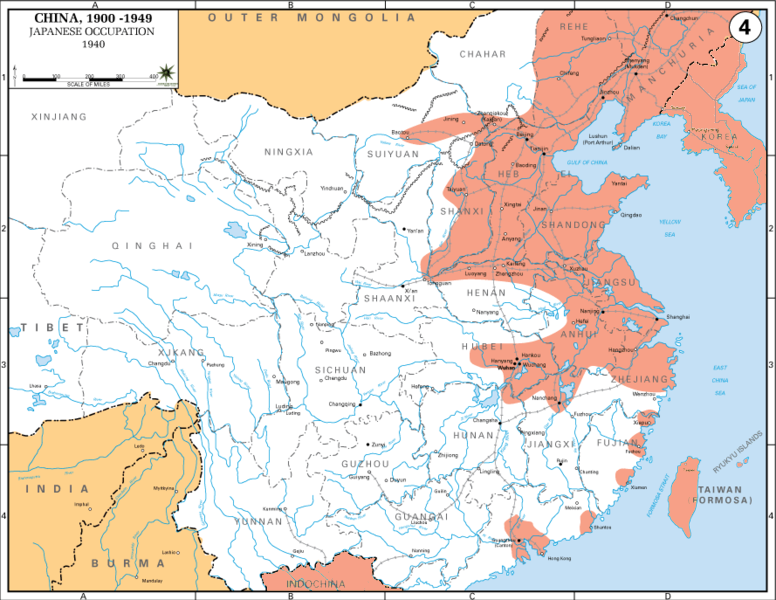
I’ve now attended four lectures on my City Lit course on Chinese history. The fourth lecture – which will be my last of the six because I’m off to Ethiopia – covered events during the Second World War.
I knew that Japan occupied Manchuria before the war but I did not realise how large that territory was. I knew that Japan later occupied the eastern coastal area of China but I did not realise how far inland the occupation extended. And I did not realise at all that the Japanese took over coastal sections in the south.
The total area of occupation was very considerable as you can see from this map (areas of Japanese control in red):
Posted in History | Comments (0)
Why the world needs water that is clean and affordable
February 3rd, 2015 by Roger Darlington
For the last three years, I have chaired the Customer Challenge Group for a regional water company in the UK (South East Water) so, more than ever, I have been aware that clean and affordable water is vital to all communities both in the UK and around the world.
But, according to the latest IFC figures:
- 2.5 billion people are without safe sanitation
- about 768 million people still lack access to clean drinking water
- roughly 3.5 million people die annually from water-related diseases
How can this be changed? You’ll find a good article on the subject here.
Posted in Consumer matters, Environment | Comments (0)